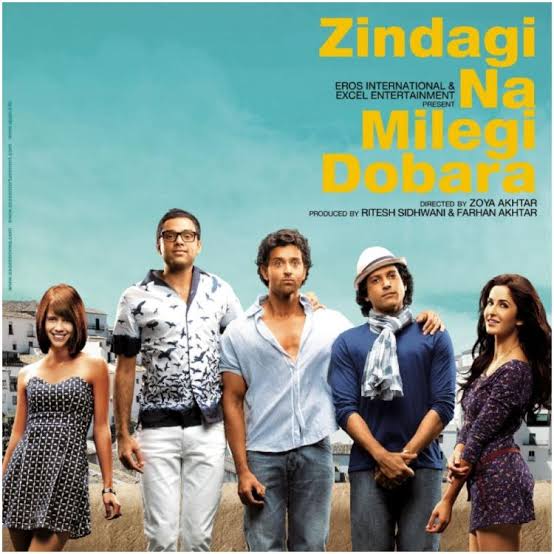
Movie: Zindagi Na Milegi Dobara
Director: Zoya Akhtar
Cast: Hrithik Roshan, Abhay Deol, Farhan Akhtar, Kalki Koechlin, Katrina Kaif
Year of Release: 2011
Zindagi Na Milegi Dobara only serves to remind me of a) my lack of money, b) my lack of friends, and c) my lack of a figure like Katrina Kaif. This movie came out 9. Years. Ago. It’s one of the classics of modern Bollywood with its ever watchability, along with Yeh Jawaani Hai Deewani, Kal Ho Na Ho, and Jaane Tu Ya Jaane Na, and watching it makes me wish Zoya Akhtar would direct my life.
3 school friends have a pact to take a boy’s trip to explore some adventure sports in Spain. This trip takes place right before one of them is to get married. It’s the model road trip story, where the actual journey is the one within, where major life lessons are learnt, and emotional baggage is let go off.
I remember seeing this in the cinema as a 10-year-old — I spent the rest of the summer humming the songs and wanting to visit Spain. I never really saw the whole movie again; throughout the years, I saw it in bits and pieces as it came on TV. It’s one of those movies you don’t think you need to see again and again, because it is still so pervasive through different mediums. Until now. I watched the whole movie again, and boy, do I have a different take on it now.
I would say spoiler alert, but do I really need to?
A lot of jokes and references I didn’t get earlier suddenly makes a lot more sense. Javed Akhtar’s poetry through Imran (Farhan Akhtar) hits harder now. Arjun’s (Hrithik Roshan) obsession with constantly working and earning resonates more. But some things remain just the same.
Imran throwing Arjun’s phone through the window will never not be funny, Natasha (Kalki Koechlin) coming to see Kabir (Abhay Deol) during his bachelor trip will always strike me as a bitch move, and “mental buoy” sends me into a fit of giggles every time.
One of the strengths of the story and the screenplay is how subtly the various layers and complexities are exposed. In the opening montage, the three main characters are shown packing and travelling separately to meet in Spain. And that sequence is enough to lay the basic groundwork of the characters: Arjun is seen packing immaculately, while Imran hastily stuffs his clothes into a bag. He spends the flight talking to the air hostess, depicting his carefree and friendly nature; Kabir passes his time watching movies, playing video games, looking out of the window, being the passive observer to the active world around him. Arjun takes out his laptop and works, picking up a business magazine to read. Arjun sleeps and wakes up with an alarm; Imran catches a few winks at the airport, and Kabir dozes on the plane. By the time we see them meet in Barcelona, these characters already feel familiar to us, and we are comfortable with them.
Each of these individual characters is given a rich backstory and a character arc of their own. Whether it’s from school anecdotes and pranks of the “three musketeers”, or Laila’s (Katrina Kaif) story of travelling, there seems to be reasons and motives behind all the actions and responses these characters let out. This is a further testament to the care to detail given by director Zoya Akhtar. The symbolism is rampant too: one of the most noticeable ones was where when they reach the bungalow at Costa Brava, Arjun instinctively goes up while the other two stay on the ground floor, symbolizing him always looking to reach higher and higher. When he reaches there, he finds a computer, tying his ascent with his work. Kabir has quite a sense of humour, but he tends to quieten down in Natasha’s presence. He even matches his clothing with her, as she establishes herself as the dominant partner in the relationship. Bits of poetry interspersed within the screenplay outline the thoughts the characters are grappling with while encouraging the audience to introspect as well.
Imran and Arjuns respective physical fears are linked to their mental fears: Arjun fears going into the water, going underwater below ground, as linked to coming down from the pedestal he was on due to his work life and going into his emotions and insecurities, and Imran fears falling: he’s afraid there will be no one to catch him, scared by the fact that Faizal wasn’t his real father. Laila guides Arjun through these literal and metaphorical fears and teaches him that life is about letting go of these fears that stagnate growth. This growth is further attested to how Arjun is in his work clothes in the beginning and loosens up into casuals in the end; a journey of him loosening up and looking at a life beyond his work. Imran learns that falling doesn’t necessarily have to be a bad thing; it’s about picking yourself up, dusting off, and moving on. This is something he learns literally after skydiving, and after meeting his real father Salman Habib (Naseeruddin Shah). He is constantly shown to be protective of what he writes in his diary; this turns out to be the poetry scattered throughout the film. It is gradually revealed how the funny guy persona masks the emotional baggage he carries. The only person he is seen confiding in is a Spanish girl Nuria (Ariadna Cabrol) who doesn’t understand his language but can see that he is not all carefree he claims to be. Coming to terms with his father forces him to grow up enough to show his friends his poetry, go as far as to publish it — to be able to embrace his funny guy persona with his inner poet, instead of the latter compromising the former.
A little bit about me: I am the most obnoxious person to watch a movie with. I will pause, I will rewind, I will freak out over camera movements and the lighting and the colours. I will take the time to explain to anyone sitting nearby why a certain shot or sequence is important not just in the context of the movie itself, but in the larger sense: what it depicts about the world and the people around us, our internalized prejudices and bigotry, and how cinema is the most effective tool there is to hold up a mirror to the mass public and encourage them to do and be better.
I also want to be an English professor. I guess that’s fitting.
But surprisingly, I couldn’t bring myself to pause while I was watching ZNMD. Sure, I noticed layers and motifs and meanings, but I just sat there rapt, marvelling at the impeccable storyline given to us by Zoya Akhtar and Reema Kagti. The camerawork, cinematography by Carlos Catalán and the sheer beauty that is Spain had me hooked.
I would say that ZNMD has remained this evergreen modern classic because, in some way or the other, everyone in this generation can relate to at least one of the main three characters; the money conscious and workaholic Arjun chasing financial security at the cost of his personal life, the emotionally distant Imran whose only coping mechanism is to be the “funny guy”, or Kabir, the constant people pleaser, who often puts his desires on the backburner for the sake of the people around him. I am all three of them. At least I try to be funny.
ZNMD is a multitude of stories all combined with one another, so everyone watching may take away something different: whether it’s a burning desire to go on a road trip yourself with your best friends, or maybe take a break. But more than that, I like to see it as a commentary on the human psyche like all other Zoya Akhtar movies, and how our experiences shape our beliefs, and how we shouldn’t say no to these experiences. because in the end, Zindagi Na Milegi Dobara.
(no pictures due to copyright issues.)

 Malik's Movie Reviews