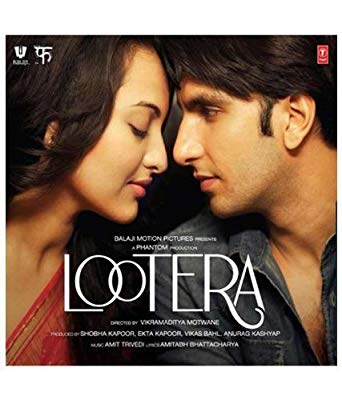
Movie: Lootera
Director: Vikramaditya Motwane
Starring: Ranveer Singh, Sonakshi Sinha, Divya Dutta, Vikrant Massey
(SPOILER WARNING)
There is a certain old world charm to Lootera. It’s style of direction, cinematography, looks and settings draw you into its world and take you back in time almost 70 years, where there was little to no urbanization, vintage cars, and vast havelis with their vast mango groves. This world created by director Vikramaditya Motwane does not share much with ours — time moves more slowly here, feelings are declared and understood through gestures, subtle glances and expressions, and more time is spent enjoying the moment than in an endless race, pursuing a mindless goal. A fair warning is due here: this world is neither for those seeking action nor the fast paced.
Inspired in part by O Henry’s acclaimed short story ‘The Last Leaf’, the movie tells of the lives of Paakhi Roy Chowdhury (Sinha) , the lone daughter of one of the last prominent zamindars of Bengal, and an archaeologist, Varun Srivastava (Singh), who claims to have come to scavenge for a civilization under the Roy Chowdhury’s land and forms a close bond with the family, but is later revealed as a conman. They fall in love, and what follows is their doomed romance.
This was Singh’s third movie, after the hits ‘Band Baaja Baraat’ and ‘Ladies vs Ricky Behl’. Whereas his first two films established him as a hero, this was the movie where he marked himself as an actor, which helped him get roles such as those of Ram in SLB’s ‘Goliyon ki Rasleela: RamLeela’, Khilji in ‘Padmaavat’ and Murad in Zoya Akhtar’s highly celebrated ‘Gully Boy’. He shines through Motwane’s lens, as quiet and reserved and then completely mad and off the hook, shifting through these personas and adapting himself to various settings, looks, and moods of his character with a ridiculous ease. Here, Varun is the archetype antihero — when exposed as a conman, no sympathy is felt for him, yet the phenomenal performance by Singh ensure that one sits up and takes notice. It is a testimony to his skill that he manages to make the audience first like him, then hate him, and at the end feel bad and sorry for him, all within a runtime of 2 hours and 20 minutes. Varun is an intense, layered character — he falls, makes mistakes, gathers up his courage, admits to those mistakes, and later redeems himself for them, and frankly, no other person than Ranveer Singh comes to mind for playing such a role.
Sonakshi Sinha, in her fifth movie, also performs well as first the childish and naïve, and later mature Paakhi, but does not reach to the levels of her co-star. This is a shame, because Paakhi has the potential of being as layered and interesting a character as Varun. Initially a girl showing almost a childlike wonder at a light turning on and off by the press of a button and experiencing love for the first time, heartbreak leaves her angry, relatively mature, but most of all, it leaves her hurt. She holds a grudge against Varun, as he broke her heart and is in a way responsible for her father’s death. But it is clear that she still loves him, and her internal battle between protecting him and leaving him to the dogs was a noteworthy scene. Paakhi’s transition from a lively bubbly Bengali girl with an evident fondness for big bindis, laali, and kajal to a mature, wiser woman is aided and depicted by a maturity in Sinha’s looks and costumes, if not her performance. Despite her wonderful looks in the film, Sinha comes across as somewhat stiff and monotonal in nature. Though Sinha did not do a bad job, relatively a good one compared to her other ventures, this was a role with more potential, and could have maybe done better by some contemporary actresses.
Music by Amit Trivedi accompanied by Amitabh Bhattacharya’s lyrics and cinematography by Mahendra J Shetty are the soul of this film— the song Zinda is one of the most stunning sequences in cinema. Supporting roles performed by the likes of the very talented Divya Dutta and Vikrant Massey add to the movie’s intensity. The music also resonates with the setting of the film, having Bengali touches, and delves into the characters and their feelings, whether it be Varun falling for Paakhi with Swanand Kirkire’s ‘Monta Re’, or Paakhi and Varun resisting their feelings for each other in Shilpa Rao’s ‘Manmarziyan’, which helps lure the audience even more into this universe. The open groves of Bengal, along with their expansive zamindari mansion in a time when electricity has just been introduced is cleverly shown in dimmed lighting. The hill setting of Dalhousie, with its hills and packed houses on cobbled streets have been done full justice to as well. Era appropriate costumes, styles and makeup for the cast add to the sheer beauty that is Lootera.
Lootera, though claimed to be one of the best films of 2013, failed at the box office. This is not a surprising fact. In an industry where masala movies are mass produced expeditiously, which are basically mindless movies focussing on the hero saving the damsel in distress, and where flashy item numbers and dancers are the norm, subtle cinematic gems such as Lootera get lost in crowd. This movie takes its time — it makes the audience appreciate things they normally might miss in their busy, hurried lives, such as the leaves moving on a tree through the wind, and the pristine beauty of the an unbounded grove, things that most of today’s movie going crowd does not have the patience for. For this is a crowd that is used to the masala films, and anything apart from that seems nothing short of a bore. It is a vicious cycle that Bollywood has found itself in — production of simple masala movies leads to audience watching and appreciating only these, such that only this is what is demanded after a while, and hence produced by profit seeking movie makers. This cycle has detrimental effects on the quality of cinema made, which has been getting lower with each passing year. So much so, it is now solely up to storywriters and directors such as Vikramaditya Motwane to and actors such as Ranveer Singh and Sonakshi Sinha to come up with films like Lootera and in more recent times, to keep the Indian audience thinking and appreciating the cinematic art, and to keep the standards of Bollywood alive and above surface.
Rewards come to those who wait. This has never been truer than with a movie like Lootera. Its slow, it takes its time, it takes the viewer through the beauty of India in the 1950’s in its own unhurried pace. It is not composed of a ground-breaking, or a completely innovative thought — in some sense, it seems almost familiar. The story, while interesting, is not exactly new, and it is easy to tell what would happen next. But it comes across as a breath of fresh air and it leaves the viewer feeling a sort of bittersweet satisfaction at the end.
This movie is not for everyone. It will not appeal to those who like to keep moving in their lives, rushing about from here to there. But if for once, you do choose to take a minute to sit down, take a breath, and look around, you might find that Lootera has a lot to offer, and that there is so much more to it than what meets the eye.

 Malik's Movie Reviews