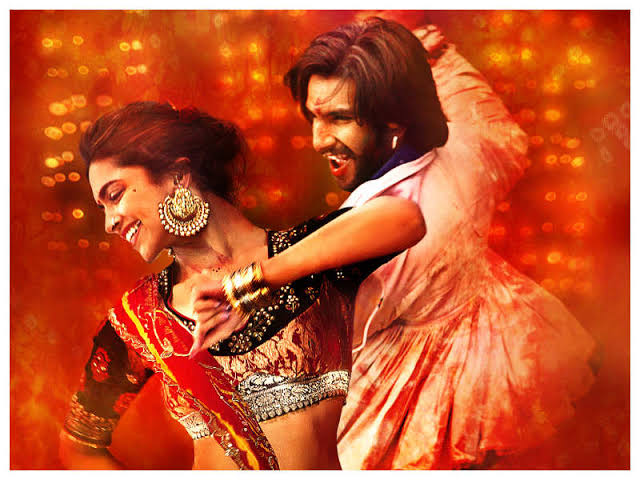
Movie: Goliyon ki Rasleela: Ram-Leela
Director: Sanjay Leela Bhansali
Starring: Deepika Padukone, Ranveer Singh, Richa Chadda, Supriya Pathak
Year of release: 2014
(Spoiler Alert)
In the opening credits of the movie, it claims to have been inspired by William Shakespeare’s (not so original) Romeo and Juliet. Ram Leela can be called a modern adaptation of that story, it has been called a “tribute to Gujarat” by director Sanjay Leela Bhansali, but for me, it is an ode to love– its ability to endure, its capacity to transcend any manmade barrier, and its inexorable power to construct and destroy, sometimes all at once.
The movie follows Ram (Singh) and Leela (Padukone), heirs of their respective clans, the Rajadis and Saneras, which have been crossing paths for the past 500 years — so much so that children are indoctrinated to hate the other. Despite all that, they fall for each other, and what follows is their desperate, ill-fated attempt to be together.
This is arguably director-producer Bhansali’s most rustic movie, especially compared to his other works like Hum Dil De Chuke Sanam and Bajirao-Mastani. Ramleela is violent and rough in its nature, and does not shy away from depicting bloodshed, cusses and intimacy. The dialogue is laced with inuendoes, and can be crass at times, a la Ram Gopal Verma. It does, however, retain the trademarks of a typical Bhansali movie with its larger than life sets, grand costumes, soulful music and raw direction and screenplay. Cinematographer Ravi Varman has managed to brighten up the barren sandy land of Gujarat with vibrant colours, but the one that particularly stands out is red. It denotes the lust and passion Ram and Leela share for each other and the blood that sheds from their warring families- no other color could have depicted their story as such. Even in the song Laal Ishq, red is used to describe their love, but their affair also called remorseful, defective, and even an enmity of sorts, giving into both positive and negative connotations of the color. But how can love be wrong?
Other colors are used to highlight Ram and Leela as opposing complements—Ram is shown on screen for the first time in purple, Leela in yellow; in their second interaction, they are dressed in white and black respectively. In their first and only night together, they are both dressed in white, which can be seen as a symbol of the peace they find in each other and their short lived unity. There is also great use of foreshadowing— for instance, Ram and Leela’s first meeting has them pointing guns at each other, which is also the case for the last meeting; and the cry of “Ram Leela ki aakhri raat” on the night of their death. A lot of symbolism is in play here, and it’s been done well, as it is in the very nature of Bhansali as a filmmaker to pay greater attention to the tiniest of details.
Some elements have been picked up directly from Romeo and Juliet, such as the first proper interaction of the characters on Leela’s balcony and her engagement to another man. Certain dialogues too are translation, a few direct while other not so. For instance, Romeos line, “What is in a name, Juliet? A rose by any other name would smell just as sweet” is given an Indian twist, with Leela asking ram, ‘Gulab ko pulao bulaaon toh khaoge kya? Naam mein kya hai?’. The music does this too — the soft ballad ‘Laal Ishq’ “apna naam badal doon, ya tera naam chupa loon/ ya chodd ke saari aag mein beraag utha loon” can be seen as an interpretation of Juliet’s famed lines, “Deny thy father and refuse thy name, for my sake and if thou wilt not be but my sworn love, I no longer will be a Capulet”.
The casting done here is completely on point– the chemistry between the leads is too real, and even supporting cast like Supriya Pathak, Richa Chadda, and Gulshan Devaiah shine their roles. Ranveer Singh as Ram Rajadi is introduced as his namesake in Hanuman Gali, as the sole advocate of peace between the rival families. His outburst on his love for Leela and the unfairness of it all is one of the most raw and touching scenes in the movie, and is also reminiscent of the titular character’s similar flareup in Bhansali’s 2002 directorial Devdas– a trademark of his movies. Deepika Padukone glows as the bold yet graceful Leela. She takes the stage when required, and makes her presence known even when she is not the centre of attention.
However stunning this movie may be, it’s not without its flaws. The romance between the main characters seems too rushed, too fast, too rash, but that can be seen as a flaw in the basic story that it’s been inspired by. The soundtrack, composed by Bhansali himself, while mostly beautiful with songs like Laal Ishq and Nagada Sang Dhol, also lags a bit with unnecessary songs like Ishqiyaon Dhishqiyaon. Some sequences were unrequired as well such as the attempts to exploit Rasila and Kesar, and coupled with the songs, they just serve to increase the runtime to a dreary two and a half hours.
Despite all that, Ramleela is still very much an enjoyable experience. This is Bhansali doing what he does best, showing grandeur and extravagance, with especially stellar casting. Watch it for what for Bhansali brings on screen, for its a visual masterpiece with memorable dialogue, one that will stay with you long after you’ve finished the film. It is as it said here, “besharam, badtameez, khudgarz hota hai … par pyar toh aise hi hota hai”.
(No pictures available due to copyright issues.)

 Malik's Movie Reviews